
Stop Waiting for Your Next Product to Find You
The Strategic Product Discovery Process: A Five-Phase Framework for Companies That Design and Manufacture What They Sell
A structured, five-phase process for finding, evaluating, and committing to the next product — designed for any company that designs and manufactures what it sells.
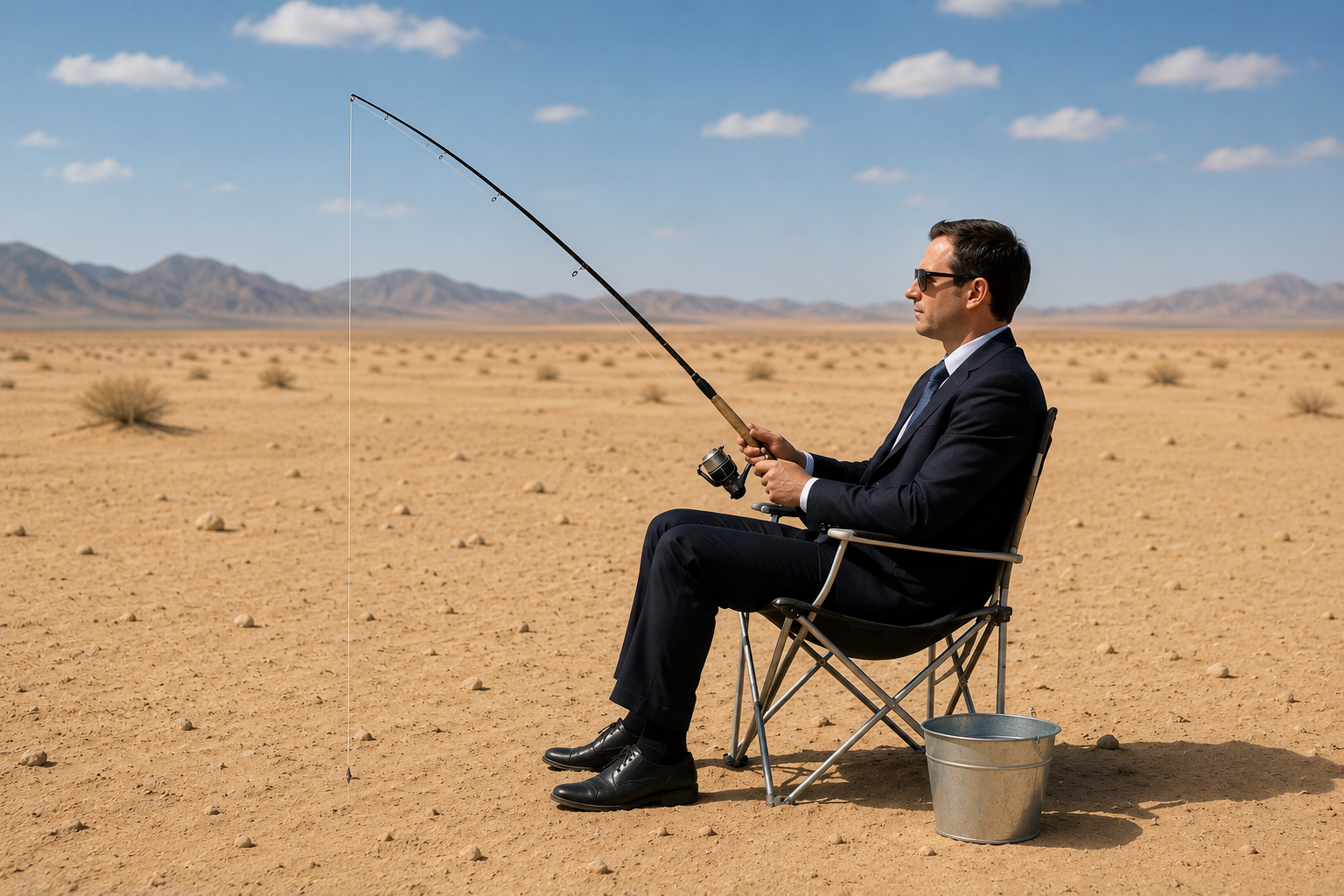
You can't find the next big opportunity if you're fishing in the wrong place. Strategic product discovery starts with knowing where to look.
There is a pattern I have seen repeat itself across companies that design and manufacture their own products — with enough consistency that I have stopped calling it a coincidence.
The company is technically excellent. The team knows how to build things most competitors can't touch. There is real customer loyalty, a track record of solving hard problems, and more than enough engineering talent to do ambitious work. And yet the business is flat. Revenue has been roughly stable for three, five, sometimes ten years. Margins have compressed. The management team knows the next strategic move has to involve a differentiated product — something the company can sell at premium margin to more than one customer — but no one has a clear picture of what that product is or how to find it deliberately.
The typical response is to wait. Wait for a customer to bring a problem that turns into a product. Wait for someone in engineering to champion a pet idea long enough that it gets resourced. Wait for a strategic planning offsite that produces a slide deck filed in a shared drive and reviewed at the following year's offsite.
I have seen what waiting costs. Engineering hours committed to multi-year custom projects that never convert to repeatable revenue. Capacity underutilized because no one can agree on where to focus it. A founding generation approaching a liquidity event without a scalable product to show for three decades of capability.
What these companies need is not better brainstorming. They need a structured process for finding, evaluating, and committing to a product — one designed for any company that designs and manufactures what it sells, regardless of industry. That process is what I want to describe here.

Waiting for the next great idea isn't a product strategy. Sustainable innovation requires a disciplined process for finding, evaluating, and developing the right opportunities.
The Premise: Finding a Product Deliberately
The assumption that the next product will reveal itself organically is almost always wrong — not because great ideas don't exist inside these organizations, but because the conditions required for those ideas to surface, get evaluated honestly, and receive a committed decision almost never happen on their own.
The ideas are there. They exist in the minds of the engineers who have built similar things for multiple customers and know that a productized version would sell. They exist in the sales conversations where customers keep asking for something the company doesn't currently offer. They exist in the project history — systems built years ago for one customer that dozens of other customers would have bought if the company had ever asked.
What's missing is the process: a structured sequence that surfaces those ideas, stress-tests them against real business logic, and generates customer validation before engineering resources are committed.
◆ FIGURE 1: The Strategic Product Discovery Process — Five-Phase Roadmap
PHASE ONE
Listen Before You Design
The first mistake most product development efforts make is convening a group too soon. Group sessions surface the socially acceptable version of what people think. The senior leader's strategic preferences frame the conversation before it begins. The person with the strongest personality carries the room. The people closest to the customer — the ones who hear the friction, the workarounds, the complaints — stay quiet.
Phase 1 is built to prevent that. Before any workshop, any framework, or any group session, I conduct individual confidential conversations with key people across the organization. The number of interviews is calibrated to the size and complexity of the business — in a smaller company, four to five conversations may suffice; in a larger or more organizationally complex one, eight to ten or more may be necessary to capture the full range of perspectives. At minimum, I speak with the senior leader, a technical lead, someone in sales or business development, and one or two people in operations. Each conversation runs 45 to 60 minutes. Nothing said is attributed by name in any group setting.
The goal is honest signal — about where the company's capabilities are genuinely strongest, what customers keep asking for that the company doesn't currently offer, what patterns emerge from projects that have and haven't converted to real revenue, and where the strategic tensions are that the team hasn't resolved.
There is also one question that the senior leader must answer before the process can move forward: Are we looking for a scalable product we can sell to many customers — or a better process for winning and executing high-margin custom work? Both are legitimate strategic directions. But they lead to different products, different investments, and different organizational structures. Conflating them is one of the most common sources of wasted effort in strategic planning. This question has to be settled before Phase 2 begins.
PHASE TWO
Understand What Customers Are Actually Trying to Accomplish
Phase 2 runs two tracks simultaneously.
The first is customer discovery grounded in Clayton Christensen's Jobs-to-Be-Done framework. The central insight is deceptively simple: customers don't buy products — they hire them to make progress in a specific circumstance. The job has functional dimensions (what they're trying to accomplish), emotional dimensions (how they want to feel while doing it), and social dimensions (how they want to be seen by others). Products that address all three are significantly harder to displace than products that only solve the functional problem.
Six to ten structured conversations with engineering and operations contacts at key customers — not sales calls, but genuine discovery conversations — focused on what customers are trying to accomplish in outcome terms, where they feel friction or constraint, what they're currently using to get the job done and where it falls short, and who inside the organization would champion a better solution. This is field research, not a survey. The conversations are designed to produce insight about underlying needs, not feature requests.
Alongside the customer conversations, I conduct a retrospective audit of the company's own project history. For every significant custom system built in the past seven to ten years, three questions: What was the customer's underlying job — stated in outcome terms, not in terms of what we built? Who else has this job, and did we ever ask? Could this system be productized and sold to others, and what would that take?
This retrospective consistently surfaces two or three product candidates that already have a proof point — things the company has already solved for one customer that others almost certainly need.
The second track applies a PESTLE analysis — not as a broad scan of the macro environment, but as a targeted lens on each promising job candidate. The question is which external forces — policy, economic cycles, workforce trends, emerging technology, regulatory requirements, sustainability mandates — are making a specific need more urgent, more solvable, or better-timed right now than five years ago. A strong PESTLE tailwind is a meaningful signal about timing and defensibility.
Phase 2 outputs a shortlist of five to eight job candidates, each with customer evidence and a timing rationale, ready to feed into the ideation workshop.
PHASE THREE
Generate Ideas Rigorously, Then Rank Them Honestly
The facilitated workshop at the heart of Phase 3 draws on structured ideation techniques developed by Bryan Mattimore — techniques that consistently produce more and better ideas than conventional brainstorming because they unlock different creative modes rather than just asking people to think harder. Depending on the complexity of the product space and the size of the organization, this session runs anywhere from a half day to a day and a half. More complex industries or organizations with deeper product portfolios typically benefit from the extended format.
Three techniques run in sequence. The first, Wishing, starts with the impossible — generating 20 to 30 unconstrained wishes about the ideal next product, then using the most evocative ones as creative springboards for realistic ideas. The second, Triggered Brainwalking, posts the Jobs-to-Be-Done candidates from Phase 2 as visual prompts around the room, then has participants rotate and build on each other's thinking simultaneously — eliminating the wait-your-turn dynamic that makes sequential brainstorming so inefficient. The third, Questioning Assumptions, surfaces the assumptions the company makes about its business — pricing, customer relationships, go-to-market, IP — and deliberately inverts the most deeply-held ones to reveal product concepts and business models that conventional thinking would never reach.
The final portion of the workshop shifts from generative to evaluative: a structured dot-voting exercise surfaces initial team instincts and produces a working shortlist that feeds into the Business Opportunity Assessment.
The BOA is a weighted scoring tool applied to the workshop shortlist. Each opportunity is scored across six criteria — strategic fit with existing capabilities, market potential beyond a single customer, Jobs-to-Be-Done strength, time to first revenue, margin profile, and IP defensibility — and the weighted scores produce a ranked list with a clear top tier and a documented rationale for what made the cut.
◆ FIGURE 2: Business Opportunity Assessment — Six Weighted Criteria
PHASE FOUR
Stress Test the Business Logic Before Committing Resources
The top two or three BOA-ranked opportunities advance to Phase 4, which applies three analytical tools in sequence to stress test the full business logic of each candidate.
The first is a Factors of Competition analysis: on the dimensions customers actually use to make decisions — capability, speed, relationships, price, customization, and defensibility — how does the company stack up against realistic alternatives? Alternatives include not just competitors, but customers building it themselves and customers doing nothing. Opportunities where the company leads on four or more factors are strong candidates. Those where alternatives are nearly equal on every dimension warrant serious scrutiny.
The second is an opportunity-specific SWOT — applied not to the business as a whole, but to the specific product concept in the specific market. The questions are precise: given this product concept, targeting this job, in this market, what are the company's specific strengths and weaknesses, and what are the specific opportunities and threats it faces?
The third, and most rigorous, is the 12-Box business model stress test. Based on the Business Model Generation framework by Osterwalder and Pigneur, the 12-Box tool stress tests the full business logic of each opportunity — from value proposition to breakeven — before engineering resources are committed. If the business model doesn't hold together on paper, it won't hold together in practice. Working through twelve structured questions — from value proposition and market segment to competitive edge, primary activities, costs, market capacity, and breakeven — the analysis tests whether the full picture is coherent before a single engineering hour is committed.
PHASE FIVE
Test the Bet, Then Make It
The opportunity that passes Phase 4 becomes the company's working hypothesis. The discipline of Phase 5 is holding it firmly enough to invest in testing — but loosely enough to change course quickly if customers respond differently than expected.
Before any testing begins, the team completes one statement:
The validation ladder tests the riskiest assumption first, with the smallest possible experiments, before engineering resources are committed. Job resonance is tested by presenting the job statement — not a product concept — to three target customers. Concept reaction is tested with a rough sketch or one-pager. NRE co-funding is proposed to a committed customer to test whether enthusiasm converts to financial commitment. Written commitment — a signed letter of intent or NRE deposit — is secured before significant engineering begins.
The decision gate at the end of Phase 5 has three options: persevere if signals are strong and commit to full product development; pivot if the job is real but the concept needs adjustment; or stop if the hypothesis doesn't hold and advance the next BOA-ranked opportunity. A pivot or stop is not a setback. It is the process working as designed.
◆ FIGURE 3: The Validation Ladder — Four-Step Customer Testing Sequence
What This Process Is Really About
The Strategic Product Discovery Process is not a product development methodology. It does not tell a company how to build a product. It tells a company which product is worth building — and it does so in a way that generates a defensible rationale, produces ideas the team owns rather than ideas imposed from outside, and establishes disciplines that outlast the engagement.
The BOA scoring tool, the bid/no-bid framework, and the 12-Box stress test don't disappear when the engagement ends. They become the company's standing process for evaluating future opportunities — the foundation for an ongoing product roadmap and portfolio review.
For companies that design and manufacture engineered products — in any industry — and have spent years waiting for the next product to find them, this process offers something different: a structured, time-bounded path to a committed decision, grounded in real customer insight, honest business logic, and the kind of validated confidence that makes execution possible.
That is what deliberate product strategy looks like for companies that build things that matter.
ABOUT THE AUTHOR
Michael V. Hoagland is the Founder and Managing Director of Hoagland Management & Consulting (HMC), a boutique management consulting firm serving manufacturers, systems integrators, and engineered-product companies across aerospace, defense, industrial, and advanced technology markets.
With more than 40 years of experience inside companies that design and build complex, engineered products, Michael has held senior operating and functional leadership roles spanning strategy, program management, operations, and business development. HMC works with leadership teams on strategic planning, product strategy, and operational execution.
To learn more about the Strategic Product Discovery Process or to discuss whether it is a fit for your organization, contact HMC at info@hoaglandmgt.com or visit www.hoaglandmgt.com.
© 2026 Hoagland Management & Consulting LLC. All Rights Reserved.